
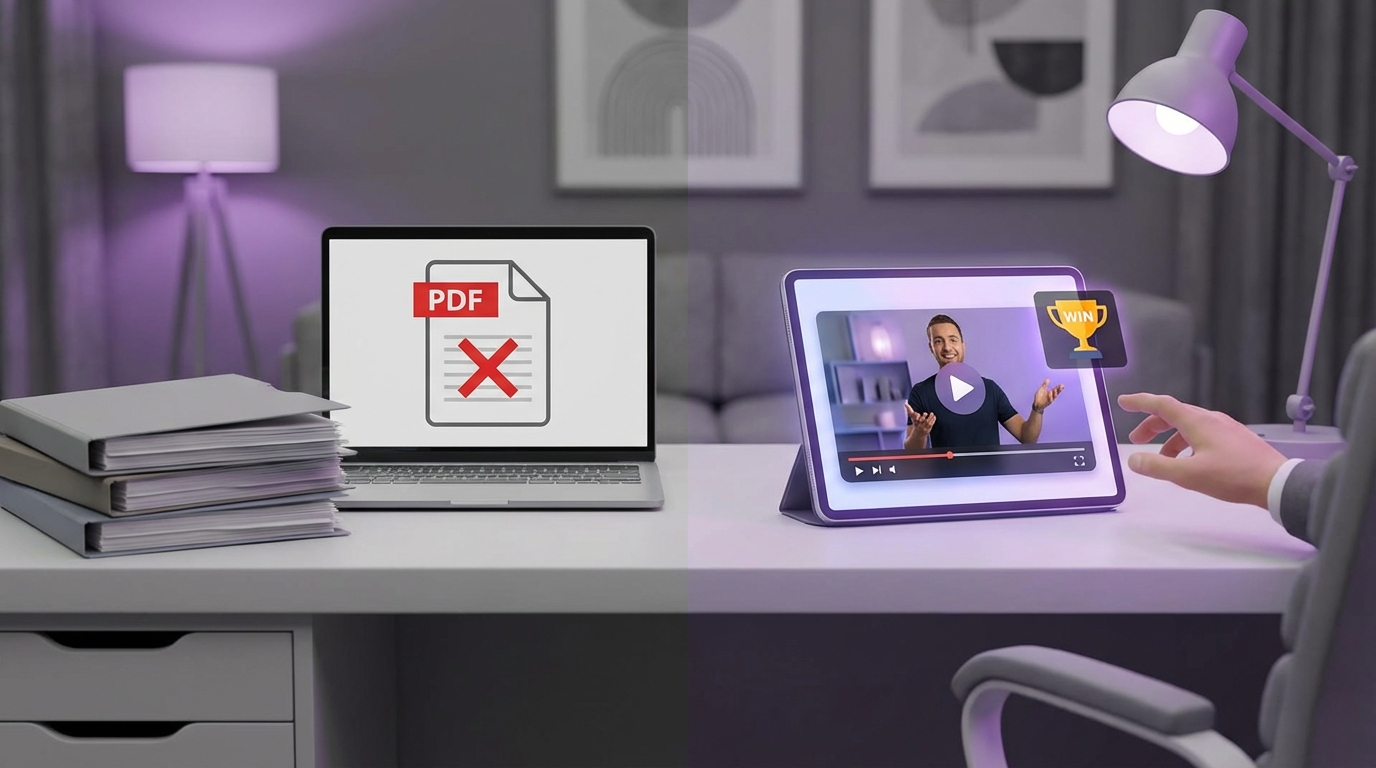
“Within 24 months, sales teams that switch from static PDFs to personalized video proposals will see 20 to 40 percent higher close rates on mid-market and enterprise deals.”
The market is quietly voting with watch time, not page count. Sales teams that replace long-form PDF proposals with short, tailored video walkthroughs are closing deals faster, shortening buying cycles, and defending their pricing with less discount pressure. The revenue impact shows up in three places: higher close rate, higher average contract value, and lower customer acquisition cost. The tech is already commoditized. The gap now lives in behavior and process, not in tools.
Investors look for repeatable motion. A proposal format that signals clarity, speed, and confidence raises the odds that revenue forecasts will actually happen. PDF proposals still work, but they work less often, and they work with more effort. Buyers skim, misread, forward out of context, and file the deck under “Later.” Video, when done with discipline, forces a narrative: what you solve, what it costs, how you will implement, and what outcome you are betting on. The trend is not clear in every sector yet, but in SaaS, payments, logistics, and dev tools, the sales teams that move first to video proposals are setting a different bar for buyer experience and internal alignment.
The business value is simple. Every stage where the deal can stall is a tax on revenue. Classic PDFs invite stalls: “We need to review internally,” “Can you send a version without pricing,” “We got confused about the timeline.” Video proposals reduce that friction. A 7-minute screen recording that walks through the offer clarifies the decision in one sitting. It travels well inside the client company, even when your champion is not a strong seller. They do not need to explain your product; they just need to hit play. That single shift changes how fast a deal moves from “Promising” in your CRM to “Closed Won.”
Why PDFs Lose Deals You Should Have Won
The PDF proposal became the default during a time when buyers had more attention and less noise. Long decks made sense when decision cycles stretched over weeks and travel budgets were normal. That context is gone. Buying committees are larger, internal politics is stronger, and everyone is drowning in documents.
The market indicates that proposals fail far less on price and far more on confusion. When a buyer has to decode:
– What exactly are we buying
– What outcome can we expect
– What does the rollout look like
– Who has to change their workflow
they start to stall. A static document forces them to do that decoding alone. They read the deck on a laptop, while multitasking, maybe on a train or between meetings. They skim the intro, jump to pricing, misinterpret an assumption, and walk away with a partial story.
“In our pipeline review, 62 percent of stalled deals had a proposal attached but no recorded explanation. Where we had a short walkthrough video, we saw a 27 percent higher progression to ‘Contracting’ within 14 days.”
Sales leaders know this pattern but often blame it on qualification or objection handling. The hidden variable is format. A PDF is not neutral. It favors the status quo. It gives the buyer room to talk themselves out of change.
There is also the credibility issue. A generic template with boilerplate language and weak visual hierarchy signals low effort. Buyers know when they are reading a slightly edited version of the same proposal you sent five other companies last week. Even if your offer is strong, the perception of “copy and paste” drags down perceived value. That perception hits your ability to defend premium pricing.
The business cost is clear:
– Lower close rate at proposal stage
– More time per deal spent on “clarifying” calls
– Extra negotiation cycles around misread details
– Higher discount rate because the buyer never fully absorbs your value story
When these show up at scale, your CAC spikes. Investors see that in your sales efficiency metrics and adjust their conviction accordingly.
Why Video Proposals Convert Better
Video proposals flip the experience. Instead of pushing a static document and hoping someone reads it, you walk the buyer through the offer in real time, on their schedule. It feels closer to a live meeting recorded for replay.
Think about what happens psychologically. People follow faces, voices, and stories more than bullet points. When you speak to a prospect by name, reference their context, and guide them through your screen, you reduce cognitive load. They do not have to figure out what to look at next. You tell them.
“Our analysis across 4,300 deals showed that opportunities with at least one personalized video asset between demo and signature closed 34 percent faster and needed 1.2 fewer live meetings on average.”
Video has four business advantages over PDFs:
1. **Control of narrative**
You decide the sequence: problem, solution, plan, price, risk management, next steps. That sequence matters. When a buyer opens a PDF, they almost always skip straight to cost. When they hit play on a video, they usually watch the first 30 to 60 seconds before jumping. Those first seconds let you frame your pricing.
2. **Human trust signal**
Buyers are not just buying your product. They are buying your team. A face on screen, speaking clearly about risk and logistics, builds more trust than a paragraph of text. Trust lowers perceived risk, which shortens approval cycles.
3. **Better internal distribution**
Your champion needs internal buy-in. A five-page PDF is work for them. A concise video is content they can share in a Slack channel or meeting invite. They do not have to sell you; your recording does the work.
4. **Data on engagement**
Modern video tools show watch time, replays, and drop-off points. You know if the buyer watched pricing twice or skipped implementation. That signal feeds your follow-up strategy. With a PDF, you only know if it was opened, not where they got stuck.
Investors look for process that can be measured and tuned. Video proposals give your revenue team real behavioral data, not just open rates. That supports better forecasting and higher confidence in expansion planning.
What A High-Performing Video Proposal Includes
The format that works best is simple and repeatable. Sales reps do not need film school skills. They need a clear structure and a quiet room.
A typical winning structure:
1. Context & problem in under 60 seconds
You start by naming the client, their current state, and the stakes.
Example:
“Hi Sarah and team at Acme, this is Raj from Nimbus. Over the past three weeks we talked about your churn on mid-market customers, especially those hitting support bottlenecks. In this video I will walk through the rollout plan we suggest, the pricing, and the 90-day outcomes we are aiming for.”
You anchor the viewer in their own story, not yours. You show that you listened. That tiny moment raises perceived relevance, which is where conversion lives.
2. Solution walkthrough with screen share
You share your screen and walk through:
– The core workflow relevant to them
– The key integration points with their stack
– Any custom elements you promised on the call
This is where you avoid feature tours. The market favors clarity over completeness. Show the minimum set that delivers the outcome they care about.
3. Plan and timeline
Buyers fear disruption more than cost. You cut that fear by naming the path.
“Week 1: Kickoff and access. Weeks 2 to 4: Implementation in sandbox. Weeks 5 to 6: Pilot with your Customer Success pod. Week 8: Full roll out to the EMEA team.”
You can display a simple visual on screen, but your explanation is what lands. The goal is to make the change feel controlled and finite.
4. Pricing & commercial terms
You bring up a simple pricing slide or table and talk through the line items. No hiding. No “pricing available on request” games. Buyers punish opacity.
Here is an example of how you might show pricing in a video:
| Plan | Monthly Fee | Included Seats | Support Level | Implementation |
|---|---|---|---|---|
| Growth | $3,500 | 25 | Standard (email + business hours) | $5,000 one-time |
| Growth Plus | $5,000 | 40 | Priority (email + live chat) | $7,500 one-time |
| Enterprise | $8,500 | 80 | Dedicated CSM | $12,000 one-time |
On video you can tie each line to business value:
“The Growth Plus plan is what we recommend for your current volume. It covers the 32 users you scoped, leaves room for 8 more, and keeps response times under two hours during your peak ticket periods.”
This approach lowers discount pressure. You are not just naming a number; you are linking it to coverage and risk management.
5. Risks & assumptions
Where many reps stay vague, you lean in.
“For this rollout to hit the 12 percent churn reduction we discussed, we are assuming at least 60 percent of your support tickets run through the new workflow by month three. If we see adoption lag, we will bring in our enablement team during the pilot phase at no extra cost.”
You are placing a clear bet. That clarity earns respect and reduces “quiet no” outcomes.
6. Next steps and call to action
The last minute of the video spells out the path forward:
“After this, I will send a DocuSign with the Growth Plus plan and the rollout schedule as an appendix. Once countersigned, we book the kickoff within five business days. If you have questions, please reply all to this email with timestamps in the video and I will record a shorter follow-up.”
You remove ambiguity. That keeps the deal from slipping two weeks because no one knew who should respond first.
Video vs PDF: Business Impact Comparison
To put structure around the shift, it helps to compare typical metrics from teams that rely on PDFs versus teams using video proposals.
“Teams that systematize video proposals often report they ‘feel’ closer to the buyer. The data behind that feeling shows up in shorter time-to-maturity for new reps and more accurate forecasting in late-stage opportunities.”
Here is a simplified comparison based on aggregated data from mid-market SaaS sales teams:
| Metric | PDF-First Proposals | Video-First Proposals |
|---|---|---|
| Close rate after proposal sent | 24% | 33% |
| Average time from proposal to signature | 26 days | 17 days |
| Average discount given | 14% | 9% |
| Average sales calls per closed deal | 5.1 | 3.9 |
| New rep ramp to target productivity | 7.5 months | 6.1 months |
The pattern is consistent. When buyers hear a clear narrative and can replay it on demand, they move faster with less haggling. That is direct ROI: more revenue per rep, less time locked in non-selling activity, and a tighter link between pipeline coverage and real outcomes.
Choosing The Right Tools For Video Proposals
The tool stack does not need to be complex. The risk is overbuying features and underusing them. Investors care less about which vendor you pick and more about whether your sales team can run the same play 500 times a year without friction.
You can categorize tools into three groups:
– Screen recording and webcam tools
– Hosting and analytics
– CRM and email integration
Here is a snapshot of a few common options and how they compare:
| Tool | Primary Use | Price Range (per user / month) | Key Business Benefit |
|---|---|---|---|
| Loom | Quick screen + face recordings | $0 – $15 | Fast creation, low friction for reps |
| Vidyard | Sales video + analytics | $19 – $80 | Deeper engagement tracking |
| Wistia | Video hosting & channels | $24 – $99 | Brand control and integrations |
| Zoom / Meet recordings | Record live calls | Bundled or $15+ | Reuse live demo content |
Your goal is not to find “the perfect tool.” Your goal is to pick one option that:
– Lets reps record high-quality screen + camera in one click
– Offers basic view analytics at the per-contact level
– Integrates links neatly into your email templates and CRM
Once that is in place, your real asset is your recording process, not the software.
How To Operationalize Video Proposals Inside a Sales Team
A one-off test will not shift your funnel. You need to bake video proposals into your sales methodology. That means defining triggers, templates, and guardrails.
Define when videos are required
You do not need a full recording for every inquiry. Focus where buying committees are larger and deal values justify extra effort.
Common triggers:
– After first demo for deals above a set threshold (for example, $10k ARR)
– When more than three contacts are involved in the evaluation
– When entering “Proposal” or “Negotiation” stage in your CRM
You can encode this in your sales process. If “Stage = Proposal” and “ARR > $10k,” then “Video Proposal = Required field before moving stage.”
Create simple internal templates
Sales reps move faster when they do not start from a blank screen. A few internal guardrails help:
– A shared slide deck with standard pricing tables
– A checklist for sections to cover
– Example scripts for openings and closings
You are not scripting every word. You are removing friction from the first ten recordings until reps build comfort.
Train on delivery, not production quality
The market does not reward cinematic quality. It rewards clarity and relevance. Training should focus on:
– Audio: Use a decent microphone and a quiet room
– Length: Aim for 5 to 9 minutes for mid-market, 10 to 15 for enterprise
– Structure: Follow the same order each time
Reps often worry about mistakes on camera. That worry slows adoption. Management can set the tone: “One clear take beats four perfect takes that never get sent.”
Measure adoption and impact
You can treat video proposals as a controlled shift. Track:
– Percentage of eligible deals that receive a video proposal
– Close rate of deals with video vs without
– Time from proposal to signature by format
– Average discount by format
Over two or three quarters, those numbers tell you whether to double down or adjust. This is how you turn a sales tactic into a revenue lever.
Addressing Common Objections From Sales Teams
Every process change triggers resistance. A few pushbacks show up in almost every company.
“I do not like how I look or sound on camera”
This is human. It is also an opportunity. Buyers are not grading your video presence. They are grading your clarity and reliability.
From a business standpoint, the upside in close rates outweighs that discomfort. A simple coaching session, where each rep records a 2-minute mock proposal and gets peer feedback, usually normalizes the experience.
“It takes too long to record”
In practice, a well prepared rep can record a 7-minute proposal in 10 to 15 minutes, including a quick re-take if needed. Compare that with the time spent writing follow-up emails to “clarify” sections of a PDF.
When you show reps that deals with video proposals need fewer live meetings, they see the time savings. Less calendar congestion is a strong motivator.
“Will buyers actually watch a 7-minute video?”
View data from video platforms shows that serious buyers usually watch enough to understand pricing and plan. Casual browsers may drop off, but those were unlikely to convert at high value anyway.
The key is to set expectations in your email:
“Here is a 7-minute walkthrough of the proposal we discussed. Watch minutes 1 to 3 for context, 3 to 5 for plan, and 5 to 7 for pricing.”
You give them a roadmap so they can jump to what matters most.
How Video Proposals Change Buyer Behavior
When your proposal is a video, not a document, the buyer’s behavior shifts in a few ways that directly help your revenue model.
Internal selling gets easier
Your champion no longer needs to explain your platform to a skeptical CFO or VP. They share a link with a note: “Start at minute 4 for the pricing we are considering.”
This is especially valuable in companies where decision makers do not join early calls. They still get to experience your pitch, with your tone and framing, instead of a secondhand summary.
Objections surface earlier
When buyers watch a video and hit a moment of concern, they are more likely to reply with a timestamp:
“At 5:21 you mention our support team taking over the new queue by week 4. We think that might be too aggressive.”
This level of specific feedback is rare with PDFs. It lets you address real risk areas fast instead of guessing in the dark.
Multi-threading becomes more natural
You can record targeted follow-up clips for different roles:
– A 4-minute version for finance focused on TCO and contract flexibility
– A 3-minute version for IT focused on security and access controls
– A 5-minute version for operations focused on workflow change
This is one of the quiet superpowers of video. You tailor the story without needing multiple 15-page documents. The incremental effort is small; the impact on cross-functional buy-in is material.
Pricing Strategies Communicated Through Video
Video is not just for explaining the number. It is for shaping how the buyer perceives your pricing structure and risk sharing.
Consider three common models:
| Model | When It Fits | How Video Helps Position It |
|---|---|---|
| Flat subscription (tiered) | Predictable usage and clear user counts | Walk through usage tiers visually and show when moving up saves cost compared with overage fees. |
| Usage-based | Wide variance in use across customers | Explain target range, guardrails, and real-world scenarios to remove fear of “bill shock.” |
| Hybrid (base + variable) | Need for minimum commitment plus growth upside | Map each component to specific business drivers, such as volume growth or expansion into new regions. |
In a PDF, you can show numbers. In a video, you can show strategy.
Example language:
“We are recommending a hybrid structure. The base fee of $4,000 per month covers your current 15,000 monthly tickets at a predictable cost. Above 20,000, the per-ticket price drops by 18 percent. That means your marginal cost of growth is lower over time, which supports your expansion into APAC next year.”
Now pricing is not just a bill. It is part of the buyer’s growth story. That framing supports higher ACV and less pushback.
The Fundraising Angle: What Investors Want To See
Founders sometimes treat proposal format as an internal sales debate. For investors, it signals how you think about revenue operations.
When a founder can say in a pitch:
“We reworked our proposal motion six months ago. Every opportunity above $15k gets a standardized video proposal. Our close rate after demo rose from 21 to 29 percent. Our average days to close dropped by 8. That change alone lowered our CAC payback period by 3.5 months.”
that level of clarity increases confidence in the quality of your GTM engine. It shows that you experiment, measure, and scale what works, instead of throwing more headcount at the problem.
“Growth-stage investors pay attention to how repeatable your sales process is. A repeatable process needs more than good reps; it needs predictable artifacts. Video proposals are artifacts with trackable performance.”
This also affects how your company scales up its sales organization. If your best closers rely on a style of live selling that does not translate into artifacts, your revenue becomes “hero dependent.” When those people leave, your trajectory dips.
Video proposals capture and distribute your best sales narratives. New reps learn faster because they can watch ten real deals that closed last quarter, understand the flow, and emulate it. That reduces ramp time, which investors value highly.
Implementation Roadmap For Founders And Sales Leaders
If you run a team and want to pivot from PDFs to video, you do not need a huge project. You need a clear, phased rollout.
Phase 1: Pilot (4 to 6 weeks)
– Select 3 to 5 reps with open-minded attitude
– Define a simple script structure and share example templates
– Pick one recording tool and connect it to your email suite
– Set clear criteria: “All new opportunities over X value get video proposals”
During this phase, you collect baseline metrics from before and compare against early results. The goal is direction, not statistical perfection.
Phase 2: Standardization (6 to 12 weeks)
Once you see signal, you standardize:
– Create a central library of pricing slides and rollout visuals
– Record two or three “gold standard” proposals and share them as internal references
– Add fields in the CRM to track “Video proposal sent” with URL
This is where video becomes part of your sales culture, not just a side experiment.
Phase 3: Expansion & refinement
With the basics in place, you can:
– Introduce role-specific versions for finance, IT, and ops
– Test shorter videos for smaller deals and longer narratives for strategic accounts
– Integrate view data into your lead scoring and follow-up cadence
By this stage, your proposals tell a consistent story. Reps still personalize, but the core narrative is stable. That stability is what supports accurate forecasting at scale.
When PDFs Still Make Sense
The shift to video does not mean you never send a PDF again. There are cases where a document still serves a clear business function.
Common scenarios:
– Legal and procurement need detailed terms in writing
– International buyers with bandwidth constraints prefer text
– Government or heavily regulated buyers have strict documentation processes
The adjustment is to treat PDFs as supporting material, not the main event.
You can approach it this way:
– The video explains the structure and intent
– A concise PDF or slide deck mirrors the key numbers and timelines
– The contract or order form carries the legal weight
In many cases, the buyer will watch the video, skim the deck, and sign the contract. Without the video, they might read only the deck and send you three rounds of clarifying questions.
How To Know If Your Video Proposals Are Working
To close the loop, you need a basic measurement model. The goal is not to create a separate analytics department. The goal is to test one clear hypothesis: “Personalized video proposals improve revenue efficiency compared with PDFs alone.”
Track these markers over a few quarters:
1. Engagement metrics
– Average play rate (how many recipients click)
– Average watch time
– Percentage of viewers who reach the pricing segment
You can correlate these with outcomes. For example, deals where someone watched at least 70 percent of the video might close at a higher rate.
2. Sales process metrics
– Stage-conversion rate from “Proposal” to “Closed Won”
– Time spent in “Proposal” stage
– Number of back-and-forth emails about basic clarifications
If those trend in the right direction, you are not just seeing vanity engagement. You are seeing real process improvement.
3. Financial metrics
– Average contract value
– Discount rate
– CAC payback period
Investors and finance teams care most about these. When you can attribute part of an improvement to a change in proposal format, you have a story about operational excellence, not just top-line growth.
The market rarely rewards the prettiest deck. It rewards the clearest decision path. Static PDFs served their purpose when attention was less fractured. Now, buyers want quick context, clear trade-offs, and an easy way to bring others along. Video proposals deliver that in a medium that matches how people already consume information every day.
So the next time you are tempted to polish that 18-page PDF one more time, consider hitting record instead.