
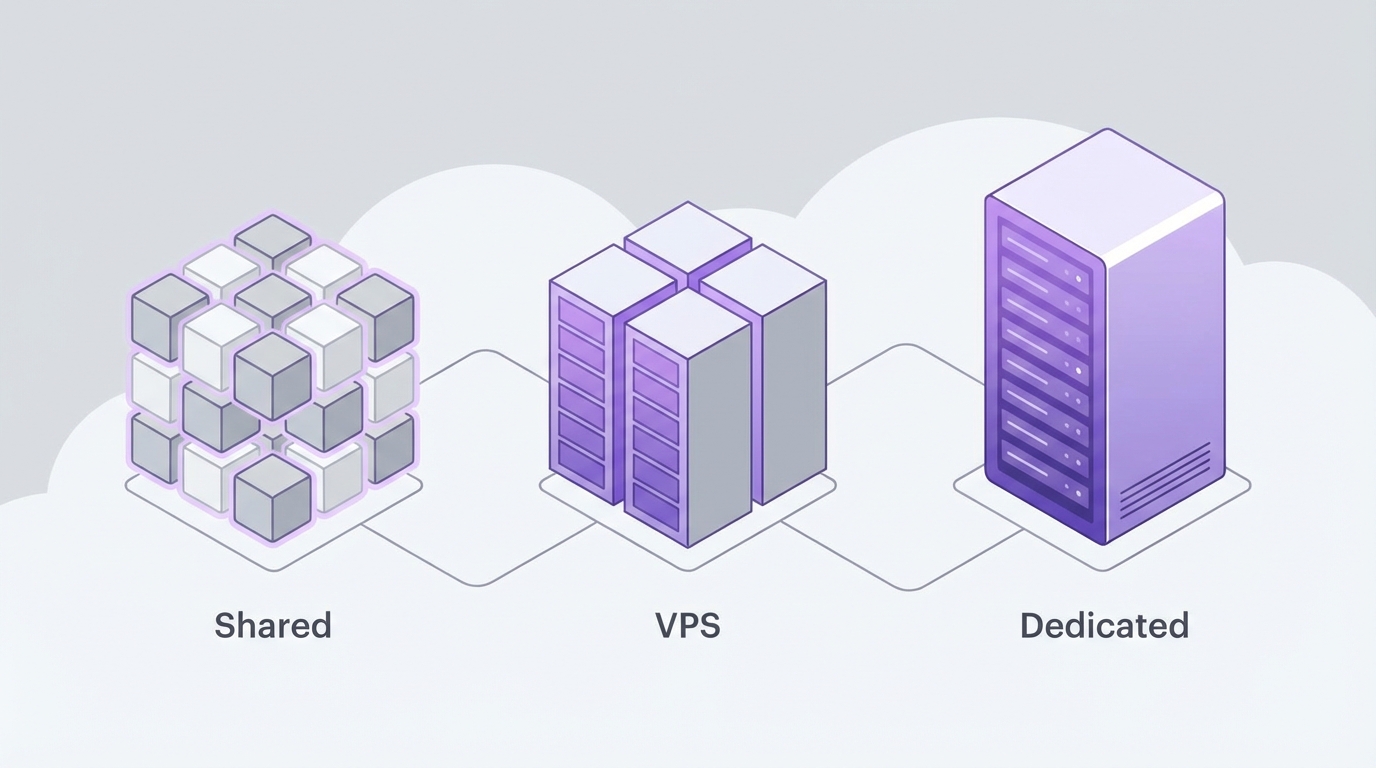
“Founders do not buy servers. They buy growth headroom and protection from nasty surprises.”
Investors look at your hosting bill as an x-ray of your business model: how you handle risk, how you treat customers, and how you plan for growth. The choice between shared, VPS, and dedicated hosting looks like a technical decision, but the market treats it as a capital allocation decision. Shared hosting buys you a cheap experiment. VPS buys you controlled growth. Dedicated hosting buys you predictability when every minute of downtime burns real money. The right choice ties directly to CAC payback, churn protection, and your ability to raise the next round without an embarrassing uptime chart.
For most early-stage SaaS, ecom, and product-led startups, VPS is the financial sweet spot. Shared hosting caps your upside and introduces noisy-neighbor risk that leaks into churn and brand damage. Dedicated servers, at the wrong stage, lock you into fixed costs that do not match your revenue curve. The trend is not fully clear yet, but the pattern across hundreds of seed and Series A decks is consistent: teams that move from shared to VPS at the first sign of traction keep better margins and smoother uptime, and they negotiate with investors from a stronger position.
This is not a story about CPUs and RAM. This is a story about how to buy time, how to manage risk, and how to keep your burn rate sane while you search for product-market fit. The hosting tier you pick sets a floor and a ceiling on what your product can do under pressure. During launches, promotions, and fundraising, that ceiling is tested in public. If your site falls over when paid traffic hits, the ROAS curve gets ugly fast, LTV shrinks, and the narrative in the boardroom shifts from growth to firefighting.
Why hosting choice is a financial decision, not a tech hobby
When a founder asks “Should I go shared, VPS, or dedicated?” the better question is “What failure am I trying to avoid, and how does that map to revenue?”
Different hosting tiers protect you from different types of loss:
– Lost revenue during traffic spikes
– Lost trust from slow performance
– Lost sleep from security incidents
– Lost flexibility from overpaying for capacity you do not use
Investors do not want you to pick the most powerful server. They want you to pick the model where each extra dollar spent has a clear line to retention and revenue. Shared, VPS, and dedicated are not just tech stacks. They are different financial profiles.
“Hosting is not about ‘Can this run my app?’ It is about ‘Can this platform support my next 10x traffic event without blowing up CAC and churn?'”
So the real framing looks like this:
– Shared hosting is like renting a bunk bed in a hostel.
– VPS is a studio apartment in a managed building.
– Dedicated is buying the whole building.
None of these are “bad”. The wrong one at the wrong stage, though, turns technical friction into real cash loss.
Defining the tiers in business terms
What is shared hosting in business language?
Shared hosting means your site runs on a server where many other customers share the same physical resources: CPU, RAM, storage, and network.
From a business angle:
– You pay very little.
– You share risk with many strangers.
– You do not have much control over performance.
– You accept that a “noisy neighbor” can affect your speed and uptime.
It is the hosting version of “cheap, noisy apartment in a crowded building.”
Founders pick shared hosting when:
– The idea is unproven.
– Revenue is low or zero.
– Downtime is annoying but not yet expensive.
– Speed matters less than just “being online.”
For a solo consultant, a simple brochure site, or a pre-MVP landing page, shared hosting can be enough. Once you start sending paid traffic or rolling out account-based features, the math changes.
What is VPS hosting in business language?
VPS stands for Virtual Private Server. A physical server is sliced into multiple virtual servers. Each slice gets guaranteed resources and its own isolated environment.
From a business angle:
– You still share the physical box, but you get your own “lane” for CPU and RAM.
– You gain control over configuration and security.
– You pay more than shared, but far less than a full dedicated box.
– Performance is more predictable, which keeps support tickets and refunds down.
This is the “serious but still flexible” tier. VPS is where most SaaS and ecom projects should live once they see real traffic and revenue.
“For 80% of early-stage SaaS, the best hosting decision is not ‘the fastest’, but ‘the most predictable performance for each dollar spent.'”
What is dedicated hosting in business language?
Dedicated hosting means you rent or own the entire physical server. No other customer lives on that hardware.
From a business angle:
– You carry the full cost of the machine.
– You get full control and predictable performance.
– You usually commit to a longer term (12 months or more) for better pricing.
– Scaling up means real planning: migration, capacity estimates, and downtime windows.
This tier makes sense when:
– Your app generates enough revenue that each minute of downtime is expensive.
– You need very strict performance and security guarantees.
– You have a stable baseline of traffic and growth that justifies fixed capacity.
Dedicated hosting can look attractive to technical founders who like control, but investors look at the fixed cost and ask: “Are you sure the revenue curve supports this?”
What the numbers usually look like
Pricing varies by region and provider, but the market clusters around some common ranges.
Typical monthly pricing bands
| Hosting Type | Typical Monthly Cost Range | Traffic Stage Fit | Who It Suits |
|---|---|---|---|
| Shared | $3 – $20 | 0 – 30k visits/month | Blogs, brochures, pre-MVP pages |
| Entry VPS | $15 – $60 | 10k – 150k visits/month | New SaaS, small ecom, serious blogs |
| Mid / High VPS | $60 – $200 | 100k – 500k+ visits/month | Growing SaaS, funded projects, busy stores |
| Dedicated (Basic) | $100 – $300 | 150k – 500k+ visits/month | Stable SaaS, regional ecom brands |
| Dedicated (High-end) | $300 – $1,000+ | 500k – millions of visits/month | Large platforms, media, high-traffic apps |
“The real cost of shared hosting is not $5 per month. It is the unknown revenue you never see because users bounce while the page is loading.”
When an investor screens your deck and sees “We run on cheap shared hosting,” the question is simple: are you genuinely lean, or are you under-investing in core infrastructure that touches every user?
The three models through a growth lens
Shared hosting: good for experiments, bad for traction
Shared hosting is about keeping upfront risk low. For a founder still testing idea-market fit, cash is more precious than latency or uptime. That is rational at the very beginning.
Business pros:
– Lowest fixed cost.
– Usually comes with managed support and “one-click” tools.
– Little to no sysadmin burden for simple setups.
Business cons:
– Performance varies with other customers.
– Harder to pass security audits or compliance checks.
– Limited control over environment can slow your engineering team.
– Reputation damage if you share an IP with spammers or hacked sites.
The real turning point: the minute you start spending real money on ads or outbound acquisition, every second of delay and every 500 error hits ROAS and payback time. At that point, the “savings” of shared hosting vanish.
VPS: the growth middle ground
VPS hosting gives you most of the control of dedicated hardware, at a fraction of the cost, and with more flexibility to scale up or down.
Business pros:
– Predictable resource allocation for your app.
– Better path to scale: you can double RAM or CPU with a plan upgrade.
– Cleaner story for security and investor conversations: isolation and control.
– Good fit for CI/CD practices and modern dev workflows.
Business cons:
– More sysadmin burden than basic shared hosting, unless you pay for “managed” VPS.
– Misconfiguration risk if your team lacks infrastructure experience.
– You still share the physical hardware, so very heavy neighbors can sometimes affect performance on cheap providers.
For most growth-stage products, VPS hits the right ROI curve. You can adjust capacity monthly while MRR grows, instead of locking into a large, fixed hardware bill.
Dedicated: when every minute has a dollar sign
Dedicated hosting becomes serious when your app has enough revenue and complexity that you need strict performance guarantees.
Business pros:
– Performance isolation: no noisy neighbors.
– Stronger story for compliance (paired with the right processes).
– Predictable baseline: you control capacity and know your limits.
Business cons:
– Fixed monthly cost, even in slow months.
– Capacity planning risk: under-provisioning means outages; over-provisioning means wasted cash.
– Upgrade cycles and migrations are heavier projects.
This model fits when:
– Uptime and latency affect large contracts.
– Your dev team needs custom configuration at every level.
– You are big enough that monthly hardware cost is small versus total revenue.
Comparing shared vs VPS vs dedicated on business-critical factors
Feature comparison that founders actually care about
| Factor | Shared | VPS | Dedicated |
|---|---|---|---|
| Monthly Cost | Low | Medium | High |
| Performance Predictability | Low | Medium-High | High |
| Control / Customization | Low | Medium-High | High |
| Security Isolation | Low | Medium-High | High |
| Scalability Effort | Low (but limited) | Medium | High (capacity planning) |
| Best Stage Fit | Idea testing / pre-traction | Early to mid growth | Late growth / stable scale |
This is where the nuance lives. Shared hosting feels “easy” to scale on paper, but only within a narrow band. Professional-grade traffic and concurrency often expose limits that are not clear from marketing pages.
VPS feels like work at the start but pays off once you automate deployments and monitoring. Dedicated asks for real ops maturity, which many seed-stage teams do not have.
ROI framing: how hosting touches your unit economics
Investors care less about whether you can handle 10,000 concurrent users and more about how your hosting footprint affects these numbers:
– Conversion rate
– Churn
– Support volume
– CAC payback period
– Gross margin
Slow pages reduce conversions. Outages increase churn. Both increase support load. All of this eats into margin.
“Every extra 100ms of latency is not just ‘slower’. It is a quiet tax on conversion that compounds month after month.”
Here is a simple mental model:
– Shared hosting is cheap but leaks money invisibly through lost conversions.
– VPS costs more but often recovers that cost through higher conversion and reduced support tickets.
– Dedicated costs the most but can protect large revenue streams when traffic and contract values are high.
If you run paid campaigns, ask this question: Does my hosting tier support the conversion rate my ad spend assumes? The answer often points straight at VPS for any real marketing budget.
When each model actually makes sense
When shared hosting is the right choice
Shared hosting is acceptable when:
– You have no product yet. You are collecting emails for a waitlist.
– Your site is static or near-static, with no heavy backend work.
– Downtime hurts ego more than revenue.
– You are not under any compliance or data sensitivity pressure.
For example:
– A solo creator validating interest in a course.
– A small local service business with most clients coming from referrals.
– A content site starting from zero, with no advertising contracts.
The key is to treat shared hosting as a temporary phase. The moment you put real money into traffic, move.
When VPS is not optional anymore
VPS starts to look mandatory when:
– Users log in and store data.
– You build features that run non-trivial processing.
– You start to see regular traffic spikes from campaigns or content.
– You care about latency across regions.
For example:
– A SaaS with even a few hundred daily active users.
– An online store with flash sales or regular promotions.
– A content business that sells sponsorships and needs uptime guarantees.
In these scenarios, shared hosting can suddenly become the bottleneck that distorts your metrics. You might think “Facebook ads are not working” when the real issue is a slow, flaky server.
When dedicated hosting is actually worth it
Dedicated hosting makes sense when:
– The app generates enough predictable revenue that a hardware bill in the hundreds or thousands per month is a rounding error.
– Existing VPS instances run hot even at high tiers.
– You need full control over network, storage, or custom stack components.
– Compliance and security reviews demand strong isolation.
Think:
– A B2B SaaS with annual contracts and enterprise clients.
– A high-traffic ecom brand where sales events create sharp traffic spikes.
– A media or streaming service where performance is tied directly to ad revenue.
Here, not having control over hardware can become a bigger risk than the cost.
Growth, funding stage, and hosting maturity
A practical way to think about this is to map hosting choice to funding and revenue stage.
Bootstrapped / pre-seed
Goals: Validate the problem, get first paying users, prove someone cares.
Hosting guidance:
– Shared hosting is acceptable for static landing pages and basic forms.
– Move to a low-end VPS as soon as you have login-based features or steady traffic.
– Cash is tight, so focus on a simple, managed VPS if your team is not strong on ops.
Investor perception:
– Shared hosting here reads as frugal and sensible.
– A small VPS can send a signal that you take user experience seriously.
Seed / early revenue
Goals: Prove repeatable acquisition channels, show user retention, start building infrastructure that can survive growth.
Hosting guidance:
– Default to VPS for any serious product work.
– Size your server based on actual usage data: CPU load, memory, and peak traffic.
– Start instrumenting performance: monitoring, alerts, basic logging.
Investor perception:
– Serious investors expect you to at least be on VPS for production apps.
– They do not want outages during demo week because your shared plan hit a resource cap.
Series A / growth stage
Goals: Scale users, refine pricing, improve margins, and harden reliability.
Hosting guidance:
– Consider multiple VPS instances or a move toward more controlled hardware as traffic and team scale.
– Dedicated hosting can make sense for core services, while still keeping secondary services on VPS.
– Invest in redundancy rather than a single massive box.
Investor perception:
– Recurrent outages from weak hosting become a red flag.
– Solid infrastructure decisions become part of your “we are ready to scale” story.
Series B and beyond
Goals: Expand markets, improve performance for large cohorts, prepare for stricter compliance.
Hosting guidance:
– Dedicated servers for core workloads can be justified, often in a mixed model.
– Focus on architecture: high availability, backups, disaster recovery.
– Negotiate contracts with providers based on your actual and projected traffic.
Investor perception:
– Infrastructure reliability is treated as assumed.
– Hosting strategy connects directly to margin and customer satisfaction.
Shared vs VPS vs dedicated: risk profiles
Hosting is also a risk portfolio choice.
Risk with shared hosting
Primary risks:
– Performance risk from other customers.
– Security incidents spreading across customers on mismanaged platforms.
– Hard limits on what tech stack you can run.
For a “just testing an idea” founder, those risks are acceptable. For a business with signed contracts, they are not.
Risk with VPS
Primary risks:
– Misconfiguration if you manage the server yourself.
– Underestimating needed capacity and causing slowdowns.
– Relying heavily on one provider’s platform features.
Many of these risks shrink if you use a good managed VPS provider or bring in part-time infrastructure expertise.
Risk with dedicated
Primary risks:
– Large fixed costs that do not flex with short-term revenue dips.
– Capacity planning mistakes that require urgent, stressful migrations.
– Single points of failure if you do not architect around redundancy.
Dedicated hosting is not inherently safer. It demands more discipline. The payoff is predictable performance when done right.
How to think about the upgrade path
Instead of asking “Which should I pick forever?” think in phases.
Phase 1: Shared to get off the ground
– Use a reputable host that makes migrating out simple.
– Avoid heavy customizations that tie you to their quirks.
– Collect basic analytics so you know when your traffic and conversions justify a move.
Phase 2: Move to VPS once money is on the line
– Start with a modest plan and watch CPU, RAM, and disk usage.
– If you lack ops experience, pay for managed VPS to avoid security and maintenance headaches.
– Automate backups and simple deploy scripts early.
Phase 3: Consider dedicated when VPS feels constrained
– Only move when you see consistent load near VPS limits, not just one-off spikes.
– Run tests or staging on similar hardware before moving production.
– Keep some flexibility with contract terms while you refine capacity estimates.
This staged approach aligns your infrastructure spend with your revenue and risk at each step.
Shared vs VPS vs dedicated through a performance lens
Performance ranges you can expect
Numbers vary widely, but performance ceilings generally look like this for a typical web stack:
| Hosting Type | Approx Concurrent Users (Well Tuned) | Where It Starts To Struggle |
|---|---|---|
| Shared | Dozens | Campaign spikes, heavy dynamic pages |
| Entry VPS | Hundreds | Sustained spikes, complex backend work |
| High-end VPS | Low thousands | Mass traffic events, high concurrency |
| Dedicated | Thousands+ | Depends on hardware and architecture |
The key for ROI: do not pay for hardware capacity that your funnel does not use. But also do not starve the app to “save” money and then lose far more in dropped conversions.
Practical scenarios: what you actually need
Scenario 1: New SaaS with 200 paying users
– Traffic: 10k visits/month, moderate backend usage.
– Revenue: Enough to cover a few hundred dollars per month in infra without stress.
– Team: 2 devs, no dedicated ops person.
Best fit: Low to mid-range managed VPS.
Reasoning:
– Shared hosting can cause random slowdowns during working hours, which your users experience directly.
– Dedicated is overkill, both in cost and complexity.
– Managed VPS lets your team stay focused on product, not patching kernels and tuning databases.
Scenario 2: Content site with affiliate revenue
– Traffic: 50k visits/month and growing.
– Revenue: Tied directly to SERP positions and user trust.
– Team: Solo publisher or small content team.
Best fit: VPS, with strong caching and a good CDN.
Reasoning:
– Shared hosting can limit CPU and concurrent connections, hurting crawl rate and user experience.
– A lean VPS with caching can support growth, protect search visibility, and support future monetization experiments.
Scenario 3: Regional ecom brand with big sales peaks
– Traffic: Normal 100k visits/month, peaks of 300k+ during sales.
– Revenue: High sensitivity to downtime and slow checkout.
– Team: In-house devs or agency.
Best fit: High-end VPS cluster or a dedicated server setup, depending on architecture.
Reasoning:
– Each minute of checkout downtime loses real revenue.
– Predictable performance during campaigns matters more than shaving off hosting cost.
– Dedicated or strong VPS clusters give you control and headroom for promotions.
Signals that you should upgrade your hosting tier
You do not need complex dashboards to know when it is time to move up.
Look for:
– Rising complaints about speed from users or support tickets.
– Frequent “resource limit reached” messages in your panel or logs.
– Failed deployments or timeouts during busy hours.
– A growing gap between marketing spend and the conversion rates you expected.
When you see this pattern on shared hosting, move to VPS. When you see it on high-end VPS with good tuning, start planning for dedicated or a more advanced architecture.
How to talk about hosting in board meetings and investor calls
Technical details rarely win board discussions. Translate hosting into business language:
– “We moved from shared to VPS, which raised hosting cost by $45/month and increased average page speed by 40 percent. Conversion on our main funnel improved by 12 percent.”
– “We are planning a move to dedicated hardware to support projected growth over the next 18 months. The annual cost is X, and it protects Y amount of revenue at peak times.”
Tie every infrastructure decision to:
– Impact on revenue
– Impact on churn and retention
– Impact on support burden
– Risk reduction during key events (launches, Black Friday, PR hits)
That framing turns hosting from a line item into part of the growth strategy.
So what do you actually need?
Strip away the tech talk, and the answer usually looks like this:
– If you are pre-traction and just collecting interest, shared hosting can be enough for now.
– If you make any real money online, a VPS is not a luxury. It is the baseline for predictable performance.
– If uptime and latency directly affect large contracts or heavy revenue days, dedicated hosting becomes a rational investment.
The market rewards teams that match their hosting tier to their actual growth curve. Under-spend on infrastructure, and you leak revenue without noticing. Over-spend too early, and you compress your runway for no gain.
Pick the smallest tier that fully protects your current revenue and supports the next growth milestone. Then revisit the decision each time your traffic, revenue, or product complexity takes a real step up.